What is Communication Accessibility?
Communication accessibility is the ability of information to be understood, interpreted, and acted upon across different ways of thinking.
It is the gap between what an organization intends to say and what people actually receive. Not whether the words are simple enough, not whether the page renders on a screen reader, but whether the person on the other end understood the message, knew what to do next, and felt included in the conversation.
Communication accessibility is an emerging discipline. There is not yet a decades long validated standard. We are building toward one. Today, most organizations have no accepted way to measure this. We believe they should.
“I have always found digital communication stressful. For a long time, I thought the problem was me.”
Erica, cofounder
That feeling has a name: Response Anxiety. Communication accessibility exists so the next person does not have to carry that cost alone, and so organizations can see where their messages leave people behind.
What communication accessibility is not
Communication accessibility is often confused with related disciplines that address parts of the problem but not the whole.
Readability
measures whether words and sentences are simple. A document can score at a sixth grade reading level and still be impossible to act on if the structure is confusing, the next steps are buried, or the tone assumes a single way of processing information.
Web accessibility (WCAG)
measures whether digital content can be perceived and operated by people with sensory or motor disabilities. A page can be fully WCAG compliant and still fail to communicate clearly to a neurodivergent reader who processes information differently.
Plain language
is an international standard, ISO 24495-1. It asks whether readers can find what they need, understand what they find, and use it. It checks this by evaluating documents with real readers, before and after publishing. It does not set a score, so results cannot be compared on a common scale across documents, teams, or time.
| Findable | Understandable | Cognitively inclusive | Actionable | Measurable | |
|---|---|---|---|---|---|
| ReadabilityFlesch Kincaid, grade level | · | ~ | · | · | ✓ |
| WCAGPerceivable, operable, robust | ✓ | · | · | · | ✓ |
| Plain languageRelevant, findable, understandable, usable | ✓ | ✓ | ~ | ✓ | ~ |
| Communication accessibilityVOICE Framework | ✓ | ✓ | ✓ | ✓ | ✓ |
Communication accessibility encompasses and extends all of these. It asks not just whether content is readable, perceivable, or plainly written, but whether it is understandable, navigable, inclusive, and actionable across the full range of human cognitive diversity.
The cost of communication that does not work for every mind
Organizations communicate constantly. Policies, onboarding documents, benefits guides, job postings, internal announcements, customer facing content. Every one of these is an opportunity for someone to be included or left behind.
Up to 20% of the workforce is neurodivergent, and the majority do not disclose. Organizations cannot see who they are communicating with. They must build communications that work for everyone by default.
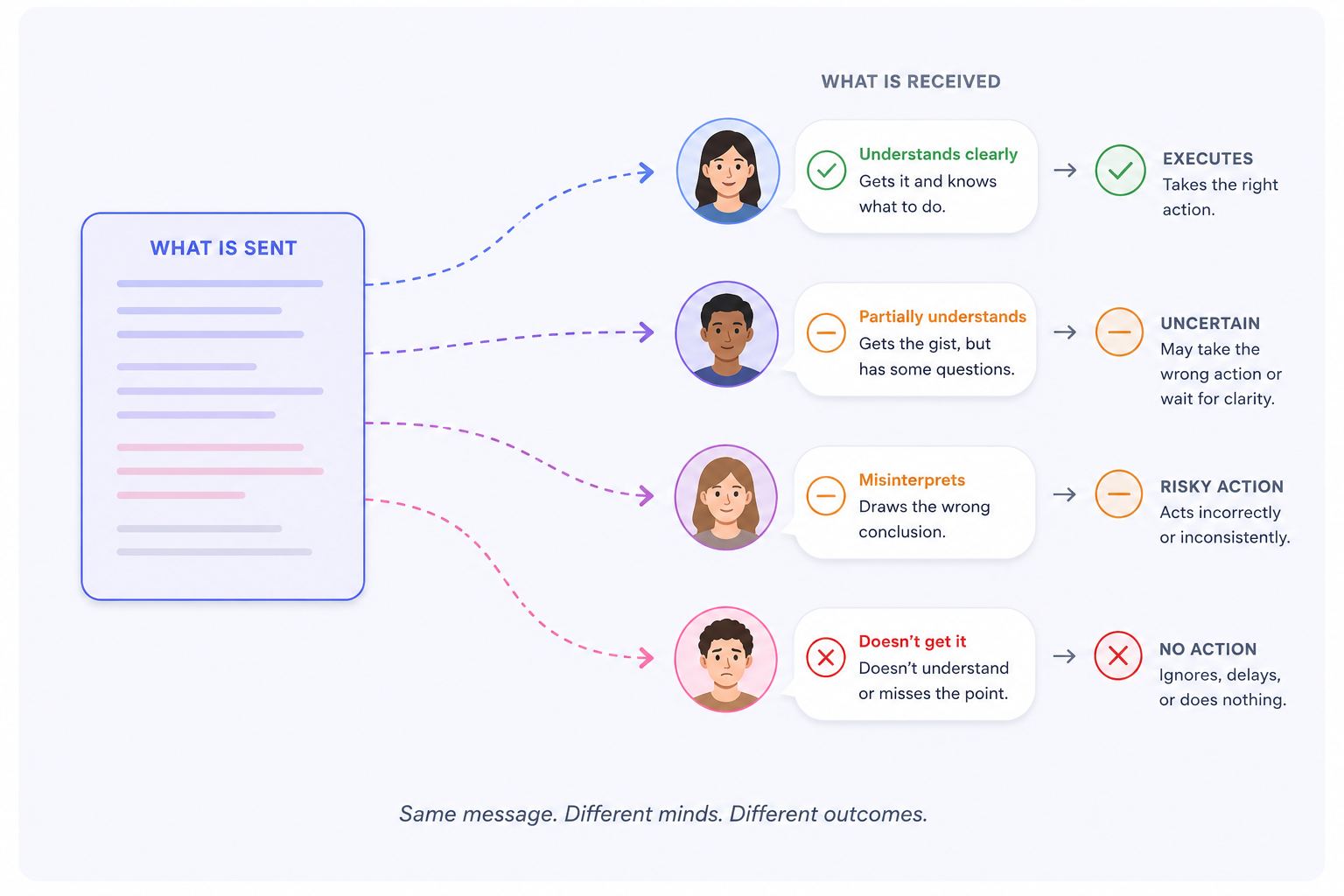
When communication is not accessible
Trust erodes
People stop reading, stop asking, stop believing the organization means what it says.
Talent is lost
Candidates who cannot decode a posting do not apply. Employees who cannot navigate onboarding disengage.
Productivity drops
Every clarification, every misinterpretation has a direct cost in time and output.
Risk increases
Accessibility legislation is expanding beyond physical and digital standards. Regulatory exposure grows.
The VOICE Framework
The VOICE Framework, developed by UniquelyND, is a proposed framework for measuring communication accessibility across five interdependent dimensions: Visibility, Orientation, Inclusion, Clarity, and Execution. It is designed to do for communication accessibility what WCAG did for web accessibility: create a shared, measurable language for identifying where communications succeed and where they leave people behind.
Developed by UniquelyND · Undergoing independent validation
Where we are
Creating a credible standard is a multi year process. We are committed to transparency about where we are in that process.
We are looking for organizations that want to lead the shift toward communication that works for every mind. Founding VOICE Partners receive:
- Early access to LINA as a founding partner
- A seat at the table shaping how communication accessibility is measured
- Opportunity to contribute communications to validation studies
- Early access to the framework and scoring engine as it evolves
- Your organization featured as a founding partner when the standard launches
Communication accessibility, clarified
What is communication accessibility?
Communication accessibility is the ability of information to be understood, interpreted, and acted upon across different ways of thinking. It is the gap between what an organization intends to say and what people actually receive.
How is communication accessibility different from WCAG or plain language?
WCAG focuses on perceivable and operable web content. Plain language improves writing clarity. Communication accessibility measures whether information can be understood, interpreted, and acted upon across cognitive styles, including findability, orientation, inclusion, clarity, and execution, which existing tools only cover in part.
Who is building a standard for communication accessibility?
UniquelyND is developing the VOICE Framework as a proposed measurement methodology for communication accessibility, built from research into neurodivergent communication needs and currently undergoing independent validation.
Explore communication accessibility
Ready to help build communication accessibility?
Join as a founding partner shaping how communication accessibility is measured, or see how your public communications score on the VOICE Framework.